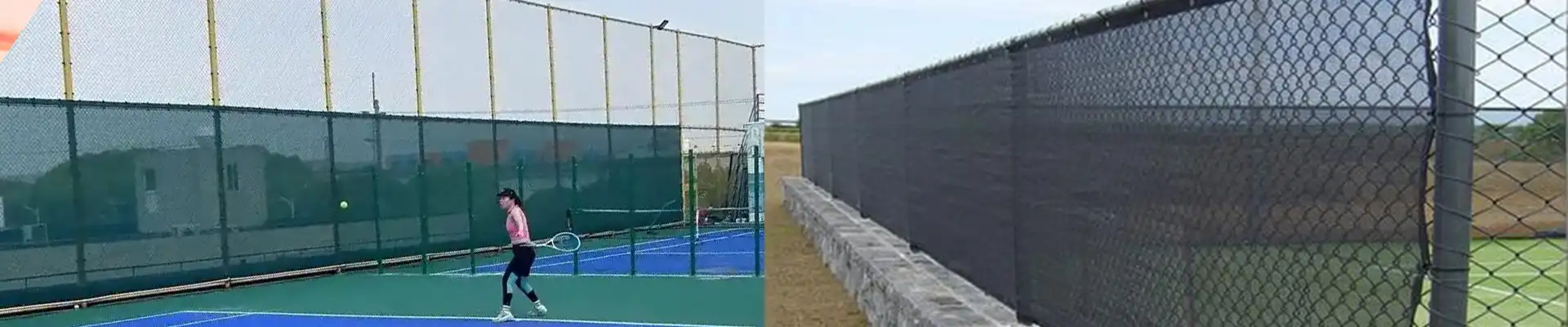
UHMWPE Barrier Netting is a high-performance barrier net made from ultra-high-molecular-weight polyethylene fibers. Its core value is to provide interception strength and energy absorption far beyond conventional materials at very low weight, while also offering hydrophobic, corrosion-resistant and UV-resistant aging performance. It is suitable for interception and protection scenarios that are weight-sensitive and require strict reliability.
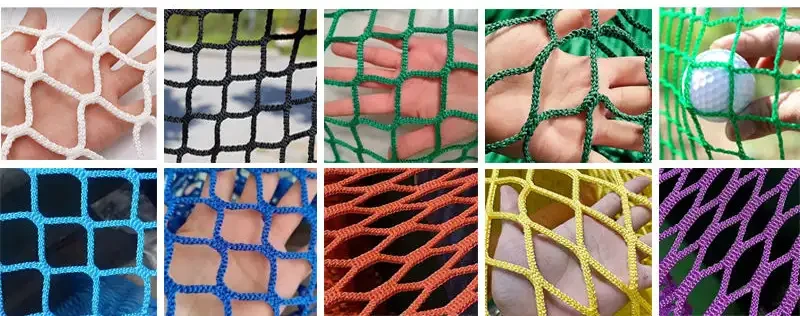
Material: Ultra-high-molecular-weight polyethylene (UHMWPE) fibers
Core advantages: High strength-to-weight ratio, low elongation, light weight, hydrophobic, corrosion resistant, UV resistant
Typical rope diameter: 6 mm (1/4 in) to 16 mm (5/8 in)
Typical mesh size: 38.1 mm (1.5 in) to 15 cm (6 in), square mesh
Typical applications: Aviation cargo barriers, marine and aquaculture barriers, infrastructure and critical asset protection
Compliance relevance: FAA, EASA or CCAR-25 for aviation applications; industry specifications for marine barrier systems
The specific strength of UHMWPE fiber is among the highest of commercially available high-performance fibers. On an equal-weight basis, its breaking strength can reach more than 10 times that of high-quality steel, and certain Dyneema® grades can reach 15 times under specific test conditions. This characteristic directly translates into two key benefits for barrier net design: the net weight can be significantly reduced while achieving the same interception strength, or a higher safety margin can be obtained under the same weight constraint.
In addition to absolute strength, another decisive indicator of UHMWPE fiber is low elongation. The breaking elongation of aviation-grade UHMWPE barrier netting is typically controlled within 4%, and some high-end specifications can be as low as 3%–4%. For barrier netting, low elongation means that after an incoming object triggers the net body, the net surface will not stretch over a large distance. The interception response is faster, and the space requirement for the protected area behind the net is also smaller.
In addition, UHMWPE fiber is hydrophobic and has a density of only 0.97 g/cm³, so it can float on water and will not gain weight or degrade due to water absorption in marine environments. This characteristic gives it dimensional stability in seawater exposure scenarios that nylon or polyester nets cannot match.
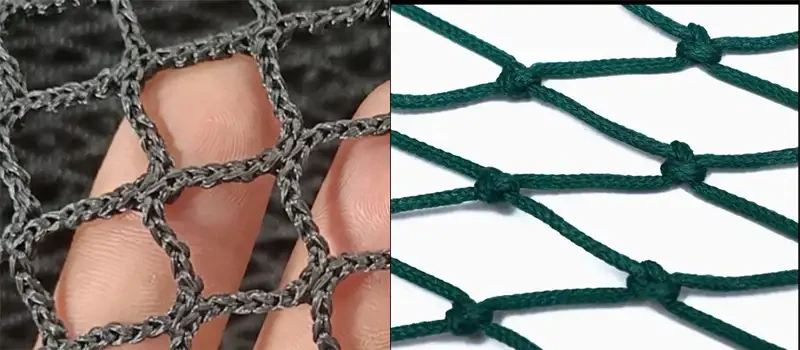
The engineering performance of UHMWPE Barrier Netting depends on the coordinated design of rope structure, mesh geometry, coating system and end connections. The following are common commercial specification ranges.
Typical products use knotless 12-strand UHMWPE braided rope as the mesh skeleton. Rope diameters range from 6 mm (1/4 in) to 16 mm (5/8 in). Square mesh sizes can range from 38.1 mm (1.5 in) to 15 cm (6 in), depending on the size of the intercepted object and the energy level. The knotless structure eliminates stress concentration and wear weaknesses at knots in traditional knotted nets, providing more uniform load distribution and longer fatigue life under dynamic impact.
For a typical #18 specification UHMWPE barrier net: the individual mesh line is a 3-strand twisted structure with a 1.75 in square mesh. The average breaking strength per mesh is 410 lb (approximately 1.82 kN). The perimeter reinforcing rope uses a 5/16 in 12-strand Dyneema® single-braid rope with an average breaking strength of 13,700 lb (approximately 60.9 kN). This strength gradient design—moderate mesh strength and high-strength border rope—is the basic logic by which a barrier net system absorbs impact energy and maintains structural integrity.
Commercial UHMWPE barrier netting is usually treated with a polyurethane coating and dyed (commonly black or gray) to improve abrasion resistance, reduce performance degradation under UV and humid conditions, and improve handling. For applications with fire-retardant requirements, a flame-retardant coating can be added. Aviation applications must meet the applicable flammability airworthiness requirements.
Standard end treatments include rope borders and corner thimbles. The latter provide metal reinforcement for anchor points and help prevent local wear at connections that could lead to early failure.
The performance combination of UHMWPE Barrier Netting—high strength, low elongation, light weight and weather resistance—gives it a clear application positioning in multiple interception and protection fields.
In aviation, the core task of a barrier net is to prevent cargo from moving forward during emergency landing or flight loads, protecting the cockpit and occupants. For example, for an aircraft with a maximum cargo load of 6.8 tonnes, the cargo barrier net must instantly restrain all cargo under 3 g acceleration. The decisive advantage of UHMWPE netting in this scenario is weight reduction: a 100% Dyneema® aviation cargo pallet net weighs about 7 kg, which can reduce weight by several kilograms to more than ten kilograms compared with traditional material solutions. This directly translates into payload gain or fuel efficiency improvement.
Airworthiness compliance is the entry threshold for this scenario. Relevant products must be strength-verified and fire-tested in accordance with FAA, EASA or CCAR-25 provisions, such as §25.305, §25.307 and §25.561. In aviation applications, UHMWPE barrier netting is usually used as an ETSO/TSO article or as a component of an approved cargo restraint system. Suppliers need to have the corresponding design assurance and quality system qualifications.
In marine environments, UHMWPE barrier netting is used for deep-water cages, marine ranching, intake and outlet debris barriers, and vessel interception systems. Its anti-fouling, abrasion-resistant and tear-resistant properties, as well as its engineering capability to withstand wind and wave loads at Beaufort scale 14 typhoon levels, enable the net body to maintain structural stability during long-term seawater exposure. This reduces mesh blockage caused by biofouling and the cost of frequent replacement. In vessel interception scenarios, UHMWPE fiber ropes are explicitly listed in specifications as an applicable material for interception mainlines, relying on rope deformation and energy-absorbing components to absorb the impact kinetic energy of an out-of-control vessel.
It should be noted that UV radiation is the primary factor in strength degradation of UHMWPE in marine atmospheric environments, and its effect is more significant than salt spray. Therefore, barrier nets used for long-term outdoor exposure should use specifications containing UV-resistant modification or surface coatings. During service, annual residual strength sampling should be carried out according to manufacturer recommendations. Some products are supplied with test coupons for this purpose.
In airports, prisons, sports venues and industrial facilities, UHMWPE barrier netting is used as perimeter barriers, anti-drone nets and impact isolation nets. Its non-metallic, no electronic signal and no power supply physical interception properties give it deployment advantages in areas sensitive to radio frequency interference and electromagnetic compatibility, such as airport surroundings. At the same interception energy level, UHMWPE netting is lighter and more flexible, and the manpower and equipment required for installation and deployment are significantly lower than those for steel wire mesh solutions. The additional load on existing buildings and structures is also lower.
The expected service life of UHMWPE barrier netting depends heavily on the type of exposure environment and whether protective measures are taken. Laboratory accelerated aging studies show that among the three typical environmental factors of salt spray, humid heat and UV, UV energy causes the most significant damage to UHMWPE molecular chains, directly leading to a decrease in breaking strength. Humid heat may cause fiber aggregation in the early stage of aging and produce a short-term fluctuation in strength.
The product implication of this finding is clear: UHMWPE barrier netting used indoors or in sheltered environments has a significantly longer strength retention period than the same product fully exposed outdoors. For outdoor installation, UV-resistant specifications should be a default requirement during selection, and periodic visual inspection and residual strength verification should be included in the maintenance plan. Commercial suppliers usually provide a 5-year pro-rated warranty as a basic service-life commitment framework. Actual replacement decisions should be based on test data rather than fixed years.
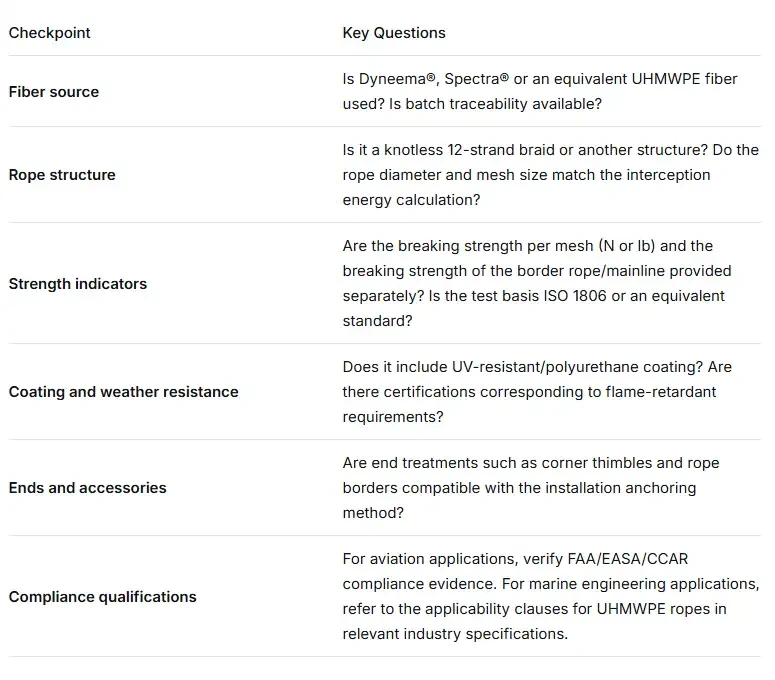
For procurement and technical selection, the following parameters and qualification items should be included in the supplier inquiry and evaluation checklist.
UHMWPE Barrier Netting is not a “generic net”, but a type of engineered fiber rope system for high-strength interception tasks. Its performance ceiling depends on the system integration of fiber grade, rope structure, mesh geometry and end design. Its applicability in a specific project is ultimately defined by three factors: interception energy calculation, environmental exposure level and compliance requirements. For interception scenarios that are weight-sensitive, space-constrained, or where traditional metal mesh solutions are difficult to deploy, UHMWPE barrier netting provides a technical path with a higher efficiency balance among strength, weight and durability.
Contact: +8615075482313
WhatsApp: +8615075482313
Email: yingruichina@gmail.com
Add: 100 meters west of Xiliangwa Village, Anping County, Hebei, China
We chat