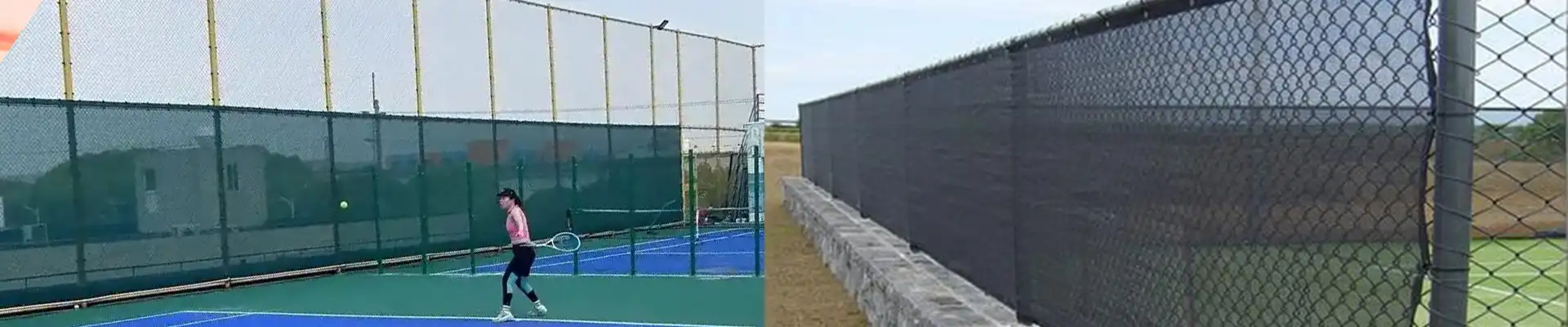
Flexible Protection, Built for the Football Field
Football field perimeter netting has long been dominated by rigid mesh solutions such as chain-link and welded wire nets. Rope netting, however, is increasingly becoming an upgrade option for more and more pitches. The core difference is this: rigid nets stop the ball through hard resistance, while rope nets absorb impact through flexibility. When a football hits the net at high speed, the rope net distributes the impact across the entire net surface through the elastic elongation of the ropes and the overall deformation of the mesh structure, rather than concentrating force on a few welds or interlocking nodes. This means less abrupt ball rebound, less permanent deformation of the net surface, and a more player-friendly contact experience near the perimeter netting.
The performance of rope netting for football fields depends first on the rope material. Current mainstream solutions focus on three types of synthetic fiber, each with a clear use case.
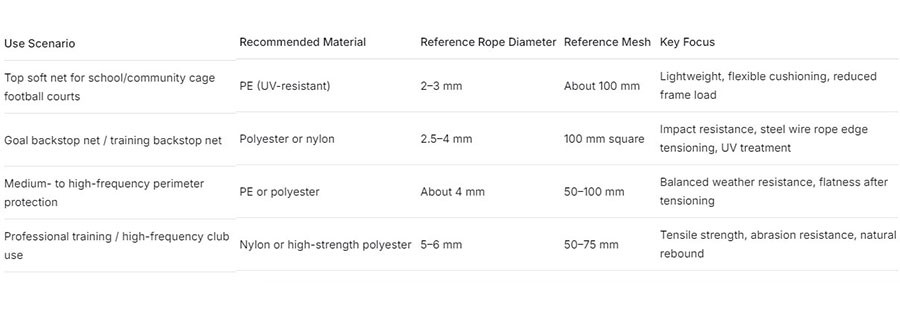
Polyethylene (PE) rope is the most widely used option for outdoor applications. Its advantages are light weight, virtually no water absorption, and resistance to acids and alkalis. After long-term exposure to sun and rain, its performance degradation remains relatively controllable, and it offers strong cost-effectiveness. It is suitable for school sports fields, community pitches, park cage football courts, and other medium- to high-frequency outdoor use scenarios. UV-modified virgin PE rope can last more than 10 years under normal outdoor use, and some well-processed products are claimed to reach up to 15 years.
Nylon (PA) rope performs better in elasticity and abrasion resistance. The rope rebounds naturally after impact and has high tensile strength. It is suitable for club training grounds, high-frequency professional training bases, and other occasions with higher requirements for “feel” and durability. It should be noted that nylon has a higher water absorption rate than PE. For long-term outdoor deployment, it must be paired with UV and moisture protection; otherwise, the combination of sunlight and moisture will accelerate aging.
Polyester (PET) rope is known for its weather resistance: UV resistance, high-temperature resistance, and resistance to deformation. After long-term outdoor exposure, it can still maintain good dimensional stability and strength retention. For areas with strong sunlight and large temperature differences, or pitches with strict requirements for long-term net tension, polyester rope netting is a “durability-first” option. Heavy-duty football backstop nets made from polyester rope can cover medium- to high-impact training protection needs when UV and weather treatment are adequate.
The protective capability of football rope netting is mainly determined by two parameters: rope diameter and mesh opening. The thicker the rope diameter, the higher the breaking strength of a single rope line and the stronger its resistance to repeated football impacts. However, increased rope diameter also brings higher weight and greater requirements for the support structure.
Common rope diameters for football perimeter netting range from 2 mm to 6 mm. 2–3 mm is suitable for light use, short-term training, or top overlay nets with lightweight requirements. 4 mm is a balanced option for school and community pitches, achieving a good balance between strength and weight. 5–6 mm is aimed at high-frequency training, official match environments, goal backstop nets that need to withstand repeated powerful shots, and side nets of cage football courts. Taking knotless braided construction as an example, when the main rope is cross-braided from multi-strand single ropes, the breaking strength can reach more than 500 kg, which is sufficient for the impact level of football.
For mesh openings, common specifications for football perimeter netting are concentrated in the range of 50 mm × 50 mm to 100 mm × 100 mm. Football training backstop nets also commonly use 4-inch (about 100 mm) square mesh. If the mesh is too large, the risk of the football passing through or getting stuck increases; if it is too small, wind resistance and rope consumption increase. A mesh of about 10 cm × 10 cm provides a relatively balanced configuration among football interception efficiency, visual transparency, and wind resistance, and is a typical configuration for rope netting.
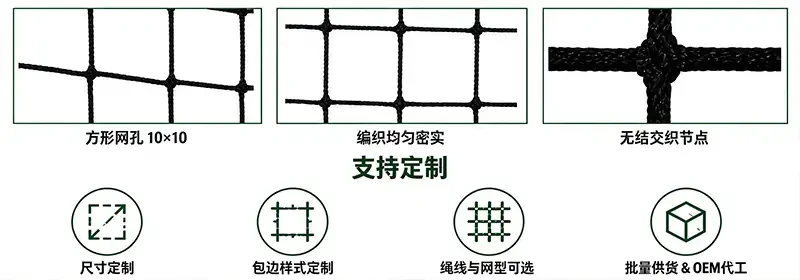
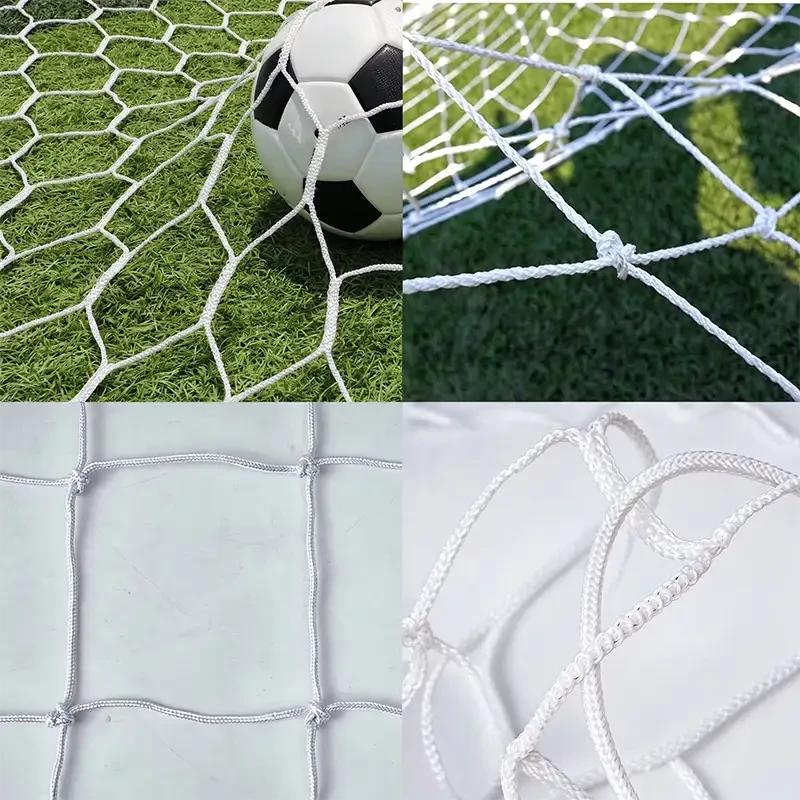
In terms of process, rope netting is divided into knotted and knotless routes. The node of traditional knotted rope netting is the weakest point under force. Under repeated high-speed football impacts, rope wear, knot loosening, and even breakage can occur at the nodes. Once a local node fails, mesh deformation spreads to the surrounding area. Knotless braided rope netting eliminates the independent “knot” structure. The ropes transition smoothly at the warp and weft intersections, and impact energy is evenly transmitted along the continuous ropes to the entire net surface. The utilization efficiency of tensile strength is higher, and the long-term stability of mesh size is better. For football perimeter netting, which needs to withstand intermittent high-energy impacts, knotless construction has clear advantages in durability and safety redundancy.
When rope netting is exposed outdoors, ultraviolet light is a more hidden “life killer” than rain. Synthetic fiber ropes without UV treatment will experience molecular chain breakage under continuous sunlight, shown as fading, chalking, and strength decline, eventually breaking suddenly in a seemingly ordinary impact. High-quality rope netting products add UV stabilizers at the raw material stage or apply weather-resistant treatment to the finished ropes to slow this process. Color choice is also related to weather resistance: dark colors (especially black) generally have better UV performance outdoors than light colors, fade more slowly, and provide a better background for identifying the football from a distance. For rainy or coastal high-humidity pitches, the low water absorption advantages of PE and polyester are more obvious, while nylon rope netting must confirm that moisture-proof treatment is adequate.
Rope netting is used in football scenarios more flexibly than rigid netting, covering multiple functional needs from “interception” to “cushioning”.
Goal backstop nets and training backstop nets are the most direct application of rope netting. Backstop nets made of polyester or nylon rope, with thickened rope edge binding on all four sides and steel wire rope tensioning, can efficiently intercept shots and passes, reduce ball-chasing time, and because the net surface is flexible, will not rebound the ball back into the pitch with great force. They are suitable for training grounds and compact pitches.
Top soft nets for cage football courts are almost an “exclusive position” for rope netting. PE or nylon soft rope overlay nets are used at the top, with weight far lower than rigid nets, significantly reducing the load on the top of the cage frame. The soft rope structure disperses local pressure through flexible deformation when a football or person accidentally touches it, which is more conducive to reducing injury risk than hard overlay nets.
For perimeter and training isolation, rope netting can serve as a lightweight protection solution behind goals, behind substitute benches, and at training zone boundaries. It is especially suitable for temporary training grounds or venues that require frequent layout adjustments. Its modular deployment and tensioning method make installation and relocation much more flexible than integrated welded net frames.
School and community pitches mainly require “safety” and “low maintenance” from rope netting. Students and ordinary players collide frequently, and usage patterns are unpredictable. Rope netting has no weld burrs or snagging hazards that rigid nets may have, and the contact surface is gentler. At the same time, PE rope netting is easy to clean and maintain; regular checks of tension and rope wear are sufficient.
Although the net surface of rope netting is flexible, the systematic requirements for installation are not low. The support structure is the prerequisite for rope netting performance. The post diameter should generally be no less than 60 mm. Football field perimeter netting posts often use 75–89 mm round tubes with a wall thickness of around 3 mm. Post spacing is recommended to be controlled within 4–6 m. Excessive span will cause the net surface to sag even after tensioning, and impact energy cannot be effectively transmitted. Concrete cast-in foundations are preferred for post bases, with a burial depth of no less than 450 mm in ordinary scenarios; for special geological conditions, the depth should be increased appropriately to ensure overall wind stability from the base.
The fixing of the rope net itself relies on edge binding, steel wire rope through the edge, and a tensioning system. Products usually have thickened edge binding on all four sides or a perimeter rope/steel wire rope threaded through. During installation, the edge rope or steel wire rope is connected to post hooks, clamps, or tensioners, and tightened evenly step by step so that the entire net surface reaches consistent tension, avoiding local slack that forms “wind-catching bulges”. Only when the net surface is tight can impact force be effectively absorbed by the elastic deformation of the rope net; a slack net surface will instead amplify impact displacement and wear.
In terms of customization, rope netting can flexibly adjust height, mesh, rope diameter, color, and edge binding method. Common football field perimeter netting heights are 4–8 m. Training backstop nets and goal backstop nets can be cut according to pitch depth and goal size. Colors are mainly dark green and black, and can also be customized according to project requirements. Edges can be equipped with waterproof fabric binding, steel wire rope, or ground anchor rings to suit fixed installation or movable scenarios.
Rope netting is not simply a “soft replacement” for rigid chain-link netting. It is a protection solution based on flexible energy absorption. Its value on the football field is ultimately reflected in three levels: for the ball—effective interception and reduced abrupt rebound; for people—gentle contact and lower risk of hard collisions; for the pitch—lightweight, weather-resistant, controllable maintenance, and a better life-cycle cost. Choose the right material and rope diameter, and make tensioning and support solid, and rope netting becomes a quiet and reliable safety boundary on the football field.
Contact: +8615075482313
WhatsApp: +8615075482313
Email: yingruichina@gmail.com
Add: 100 meters west of Xiliangwa Village, Anping County, Hebei, China
We chat