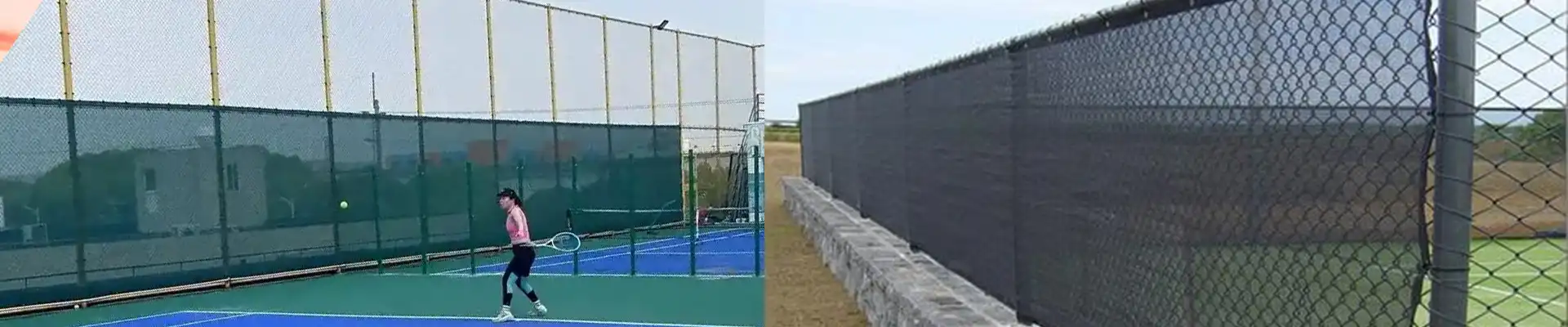
In brief, monofilament windbreak netting place greater emphasis on strength and durability, making them suitable for environments that require long-term, high-intensity use. Flat tape windbreak netting, on the other hand, highlight flatness and low cost, and are therefore better suited for applications where appearance and budget are more important.
The specific differences can be examined from the following perspectives.
Raw material form is the most fundamental distinction. Monofilament netting are made from single, relatively thick plastic filaments that have a round or nearly round cross‑section. Flat tape netting are produced by stretching plastic raw material into flat strips, which is why they are also referred to as slit‑film or tape yarn netting.
Physical properties and performance differ significantly due to the different filament shapes. In terms of strength and toughness, monofilament netting are superior because their denser structure provides better tensile strength, impact resistance, and overall toughness, with a clear advantage in abrasion resistance. Flat tape netting are comparatively softer. For durability, monofilament netting last longer because their single‑filament structure is less prone to breakage, and even if local damage occurs, it does not easily cause a linear unraveling that leads to widespread failure. Monofilament netting also incorporate UV stabilizers and anti‑aging agents more effectively, extending their service life under strong sunlight. Regarding mesh flatness, flat tape netting are smoother and more orderly, with clear warp and weft lines, whereas monofilament netting may be somewhat less even. For breathability, monofilament netting often perform better, as they are commonly used in agricultural shading where good air circulation is essential.
The main application scenarios reflect these characteristics. Monofilament windbreak netting are frequently used in demanding environments such as coal yards, power plants, and ports for dust suppression, as well as in agriculture and horticulture where long‑term protection against harsh weather is needed. Flat tape netting, due to their flat surface and lower cost, are often chosen for construction site fencing, sand fixation, and some insect‑proof netting where extreme strength is not required.
Both types reduce wind speed through physical obstruction, thereby achieving dust suppression. Monofilament netting can effectively reduce wind speed inside the protected area by 70‑90%, with dust suppression rates reaching 75‑98%. Flat tape netting offer similar performance, for example a single layer can achieve 65‑85% suppression. The actual effect also depends on factors such as porosity and weaving technique.
When choosing between the two, consider the following aspects. First, evaluate the usage environment. If conditions are harsh with strong winds, high UV exposure, or abrasive particles, monofilament is the preferred choice. For milder environments where flatness is important, flat tape netting may be more suitable. Second, assess performance requirements. If high tensile strength, impact resistance, and long service life are critical, choose monofilament. If visual smoothness and neatness are a priority, flat tape is better. Third, consider the budget, as monofilament netting are generally more expensive than flat tape netting. Finally, it is always advisable to consult professional windbreak net suppliers or manufacturers, provide them with your specific needs and site conditions, and let them recommend the most appropriate type.
Contact: +8615075482313
WhatsApp: +8615075482313
Email: yingruichina@gmail.com
Add: 100 meters west of Xiliangwa Village, Anping County, Hebei, China
We chat