A badminton net may look like a simple mesh stretched between two posts, but in professional and recreational play, its material, mesh accuracy, top-band structure, and weather resistance directly affect shuttle flight, long-term tension, and how long the net lasts indoors or outdoors. This guide covers the key product features of a badminton net, from standard dimensions and materials to structure, use cases, and buying checks.
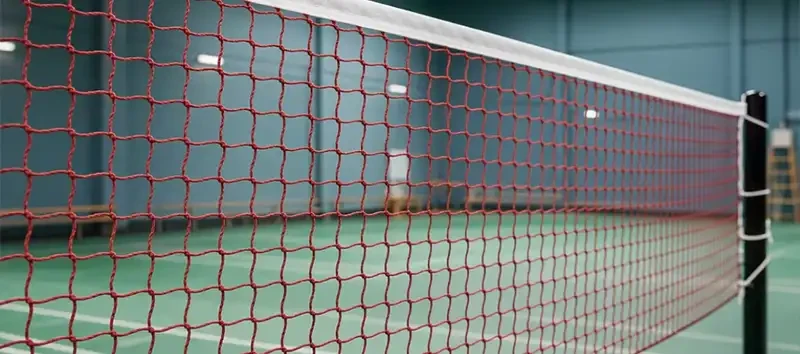
A standard badminton net is at least 6.10 m long and 760 mm wide, with square mesh openings of 15 to 20 mm.
Net posts are 1.55 m high; the net top is 1.55 m at the doubles sideline and 1.524 m at the center.
Nylon is common for competition and club nets; polyethylene is preferred for outdoor weather resistance.
The top band, edge binding, eyelets, and tensioning system are the parts that most often determine durability.
Match the badminton net type to the venue: competition, training, or portable outdoor use.
The first distinction for a badminton net is whether its dimensions and mesh meet basic project standards. Under BWF and commonly used national standards, a standard net is at least 6.10 m long and 760 mm wide. The mesh is uniform and square, with sides between 15 and 20 mm. This range matters because a standard shuttlecock cork is about 25 to 28 mm in diameter. Mesh that is too large can cause unnatural pass-through or snagging at the net, disrupting the rhythm of a rally.
For height, posts stand 1.55 m from the ground. When the net is tensioned, the top edge is 1.55 m at the doubles sideline and 1.524 m at the center of the court, where natural sag is allowed. This slightly higher-at-the-ends and lower-in-the-middle tension profile is a detail that separates a badminton net from many other sports nets. It requires both tensile strength and even tension distribution along the top edge.
A standard badminton net should also have a white double-layer cloth band about 75 mm wide along the top, with a thin steel wire rope or nylon cord running through the pocket for hanging and tensioning. The net body is usually dark, such as yellow-brown or grass green, to reduce visual distraction.
The net body of a badminton net is mainly made from nylon or polyethylene.
Nylon nets offer high tensile strength and good elasticity. They can absorb the instant impact of a fast shuttle and reduce the risk of line fatigue and breakage, making them common for competition and club training nets. BWF-approved competition nets often use braided nylon rope with mesh accuracy around 19 mm, combined with edge binding and a reinforced top band to keep the net shape stable under repeated tensioning and shuttle contact.
Polyethylene nets are known for weather resistance, with stronger waterproof and UV resistance for long-term exposure to sunlight, rain, and temperature changes. Some premium products blend polyethylene with nylon to improve flexibility while enhancing UV aging resistance. An indoor net without UV treatment will gradually yellow, harden, and become brittle if left outdoors. This is not necessarily a quality defect; it reflects a different material design for a different use case.
The first failure point on a badminton net is often not the center mesh but the top edge and borders. When a shuttle brushes the net, the top band takes the greatest instantaneous pressure and friction. Under wind load and repeated tensioning, edge stitching is also the first area to be pulled.
A good badminton net usually uses a PVC-coated cloth or double-layer heavy canvas top band with double-needle stitching to distribute tension and prevent edge unraveling. A steel wire rope or high-strength nylon cord runs through the top band, with metal eyelets and tie ropes at both ends for secure attachment to the posts and to prevent slack. Edge binding is equally important. Four-side binding or overlocked edges can significantly improve abrasion resistance and reduce the chance of mesh unraveling from the corners.
The tensioning system directly affects the user experience. Professional badminton nets often rely on ropes or steel cables on the posts for manual tensioning. Portable outdoor sets often integrate a hand tensioner or anti-sag winch system for one-pull locking and less repeated adjustment. Even tension along the top edge matters more than maximum tightness. Local over-tensioning can deform the net, while local slack can create center sag and change the net height.
Badminton net products generally fall into three categories. The right choice depends on the venue and accuracy requirements, not simply on price.
Competition and club-level badminton nets prioritize precise dimensions, stable tension, and material durability. Typical features include a braided nylon net body, 19 mm-class mesh, double-needle stitched PVC top band, and corrosion-resistant metal eyelets. Some products explicitly state compliance with BWF and national competition rules. These nets suit fixed venues, club training, and official matches, but they are not designed to remain outdoors under sun and rain for long periods.
Training and school badminton nets moderately simplify materials and accessories while retaining core mesh specifications and top-band structure. They offer better value for high-frequency use in non-elite competition settings.
Portable and outdoor badminton net sets rearrange priorities: weather resistance and fast setup come before millimeter-level height accuracy. These products often use lightweight telescopic poles, self-standing bases, or ground stakes, with PE or UV-resistant nylon net bodies and carry bags. They suit yards, lawns, beaches, parks, and other non-professional venues. For casual outdoor use, there is no need to pay for competition-grade fine adjustment. Conversely, if net height and straightness matter, portable outdoor frames often cannot match the precision of fixed indoor posts.
Check the actual mesh size first. It should fall within 15 to 20 mm and be uniform. Mesh that is too large or visibly uneven will directly reduce shuttle performance at the net.
Check the top-band stitching. A double-needle stitched PVC or canvas top band is more resistant to brushing friction and repeated tensioning than a single-layer thin cloth edge.
Check edge binding and eyelets. Four-side binding and metal eyelets are the basis for long-term use without loosening or corrosion.
Check whether the material matches the use case. For fixed indoor use, a braided nylon net body is a good option. For frequent outdoor setup or long-term exposure, prioritize PE material or products clearly labeled with UV treatment.
Finally, for formal training or competition, confirm whether the product states compliance with BWF or relevant competition rules. This is more useful than comparing weight or price alone.
A standard badminton net is at least 6.10 m long and 760 mm wide, with mesh openings of 15 to 20 mm. The top edge is 1.55 m at the doubles sideline and 1.524 m at the center.
Nylon offers better strength and elasticity for competition and club play. Polyethylene offers better weather and UV resistance for outdoor use.
The top band, edge binding, eyelets, and tensioning system are the most important durability features because they take the greatest friction and tension.
A good badminton net should not draw attention when mounted. It only needs to maintain the right height, the right mesh, and the right tension on every shuttle pass, and then do the same after the next season and the next rain.
Contact: +8615075482313
WhatsApp: +8615075482313
Email: yingruichina@gmail.com
Add: 100 meters west of Xiliangwa Village, Anping County, Hebei, China
We chat