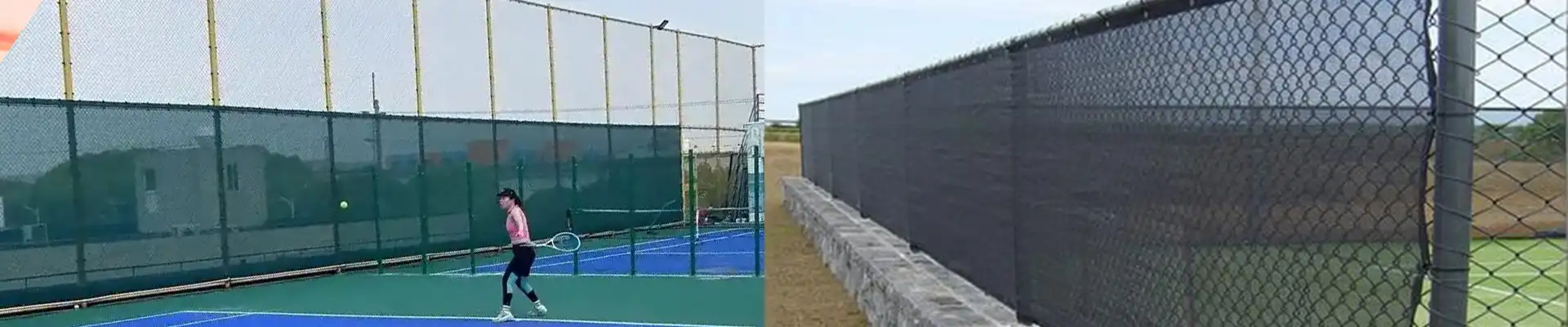
Netting is the component where the performance of a cricket practice net is most concentrated. It determines whether the ball is contained reliably, whether the batting feel is realistic, and how long the whole system will last. The following sections cover material, construction, core specifications, edge treatment, standards and lifespan.
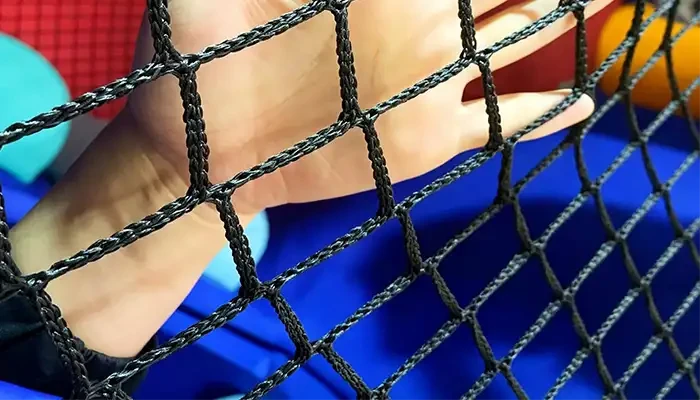
The mainstream materials for cricket practice net netting are HDPE (high-density polyethylene), polypropylene (PP) and polyester. Nylon is also used, but it is no longer the mainstream choice for club-level products.
High-tenacity polypropylene (PP) is currently the most common netting material in club-level fixed nets and dismantlable systems. Nets4You’s heavy-duty fixed cages and double-layer practice net sets are clearly specified as using high-tenacity knotless polypropylene, and Huck Nets’ ECB-standard netting is also based on high-tenacity polypropylene. Its advantage lies in the balance between flexibility and resistance to repeated impact: when a cricket ball hits the net, the netting surface deforms, and polypropylene has good flexural fatigue resistance, making it suitable for frequent hard-ball impact.
HDPE is widely used in sports netting. Its tensile strength is higher than that of polypropylene (approximately 31.7 MPa versus 23.4 MPa), and its rigidity and UV resistance are also stronger. Some heavy-duty replacement netting is labelled “UV-treated HDPE polypropylene”; in practice, this is a copolymer or blend that combines the strength of HDPE with the processing characteristics of PP. Pure HDPE netting appears more often in mid-to-low-price cricket practice nets or general sports netting products, while club-level ECB-approved products are still mainly specified as high-tenacity PP.
Polyester deserves a separate note. Its breaking strength is solid: Huck Nets’ 3mm knotless polyester netting is specified with a 1.10 kN breaking strain, while being lighter than knotted netting of equivalent strength. The drawback of polyester is that it is heavier than PP, so it is less advantageous in scenarios requiring frequent dismantling or large-span suspension. However, for fixed installations where maximum strength at individual points is the priority, it is a practical option.
For nylon, reference data include a twine breaking strength of 86 kg and a knot breaking strength of 105 kg. However, nylon’s UV resistance and creep resistance are usually inferior to those of polypropylene and polyester, so it is not the first choice for long-term outdoor fixed installations.
Knotless is currently the mainstream process for ECB-standard club-level netting. Nets4You’s ECB-approved products and Huck Nets’ 40mm mesh products both use knotless construction. The core advantage of knotless netting is that it eliminates stress concentration at knots: knotted netting creates a strength reduction at the knots, and wear and breakage after repeated impact often start at the knots. In knotless netting, the twines are directly fused or braided at the intersections, so the load is distributed more evenly. It also reduces the “snagging” or “catchiness” when the ball contacts the net, giving the batter cleaner feedback.
Knotted netting has not been eliminated; it appears in a different specification band. Huck Nets’ black knotted cricket net uses 1.8mm twine and 50mm mesh and is also marked as conforming to ECB standards. Its selling point is that the knots themselves absorb a considerable amount of wear, which can be an advantage under rough, high-wear conditions. The ECB’s indoor venue guidance also accepts both specifications: 50mm knotted (knot-to-knot) or 40mm knotless (weld-to-weld) square mesh. This shows that knotted netting is not synonymous with low-end in cricket nets; it is a parallel process route with clear application boundaries alongside knotless netting.
Club-level hard-ball practice netting is highly concentrated around the combination of 40mm mesh + 2.3mm twine diameter. Nets4You’s heavy-duty fixed cages and double-layer sets, Collins Nets’ 40mm cage netting, and Huck Nets’ replacement cage netting all use this specification. 40mm mesh stops hard balls while maintaining sufficient visibility, and 2.3mm twine provides the impact redundancy required for frequent club use.
For reference, 50mm mesh + 1.8mm twine is a common configuration in knotted netting, positioned toward the medium-to-light-duty or ball-stop fencing end of the market. The larger the mesh and the thinner the twine, the higher the risk of deformation and penetration when stopping fast hard balls; such netting is more suitable for soft balls, youth training, or cost-sensitive semi-permanent installations.
One detail that is easily overlooked is weight per unit area. Collins Nets’ 40mm / 2.3mm netting is specified at 90 g/m², while Haverford’s 2mm / 40mm knotted netting is specified at 135 g/m². Weight per unit area is not “the higher the better”; it reflects the amount of material used per unit area and must be judged together with twine diameter, mesh size and material. 2.3mm knotless polypropylene at 90 g/m² is a lightweight, efficient design. If knotted netting with a similar twine diameter has a significantly higher weight per unit area, it means that the knots and braided structure use more material, which does not necessarily translate directly into stronger impact resistance.
Netting failure often does not start in the centre of the netting panel, but at the edge fixing points or cut edges. Club-level products generally use 3mm braided rope bound-edge stitching: Nets4You’s heavy-duty cage netting is specified with “reinforced stitched edges with 3mm braid”, and Huck Nets sews in 3mm braided rope and overlock-stitches the edge to prevent fraying and tearing. Polyester knotless products use 5–7mm reinforcement rope around the full perimeter. Differences in edge treatment are not visible in the central batting feel, but they directly determine the actual lifespan of the netting under wind load, tension and local stress. When choosing, this point deserves to be checked as a hard specification alongside mesh size and twine diameter.
In the context of netting, ECB standards mainly refer to two types of requirements: mesh specification (50mm knotted or 40mm knotless) and basic material compliance. Club-level products from mainstream UK suppliers such as Nets4You, Huck Nets and Collins Nets are generally marked “Conforms to ECB standards”. It is important to note that ECB compliance is a product-level claim; it does not mean that the netting automatically meets venue safety requirements under any installation conditions. Installation method (tension, fixing point spacing, base ballasting) also affects the final safety redundancy.
UV stabilization is the dividing line for outdoor netting lifespan. Untreated polypropylene embrittles quickly under strong sunlight, while UV stabilization can significantly delay this process. Market feedback suggests an outdoor service life reference value of 5–6 years, but this depends heavily on sunlight intensity, installation tension and maintenance frequency. HDPE is superior to polypropylene in UV resistance, which is one reason why some heavy-duty replacement netting uses an HDPE base material. A practical judgment is that even with UV stabilization, fixed netting in high-sunlight areas should be systematically assessed for replacement around the five-year mark, rather than waiting for visible embrittlement or breakthrough.
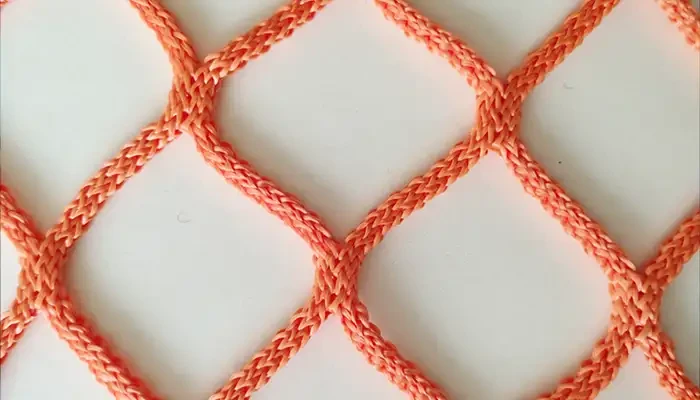
Hard-ball, high-frequency club use → knotless high-tenacity polypropylene, 40mm mesh + 2.3mm twine, 3mm braided rope bound edge, ECB marking, UV stabilization. This is the most mature and transparent specification range currently available on the market.
Hard-ball, medium-to-low frequency or semi-permanent use → choose between knotted and knotless according to installation method and wear environment: for frequent dismantling and a cleaner anti-snag feel, choose knotless; for fixed installation, high edge-wear risk and budget sensitivity, a 50mm knotted / 1.8mm twine ECB-compliant product is a reasonable lower-tier option.
Soft ball, youth or portable scenarios → mesh can be wider, twine can be reduced to 1.5–2.0mm, and PP or polyester can be used. There is no need to pay a premium for hard-ball redundancy. Even so, UV stabilization remains the baseline requirement for outdoor use, not an optional extra.
Contact: +8615075482313
WhatsApp: +8615075482313
Email: yingruichina@gmail.com
Add: 100 meters west of Xiliangwa Village, Anping County, Hebei, China
We chat