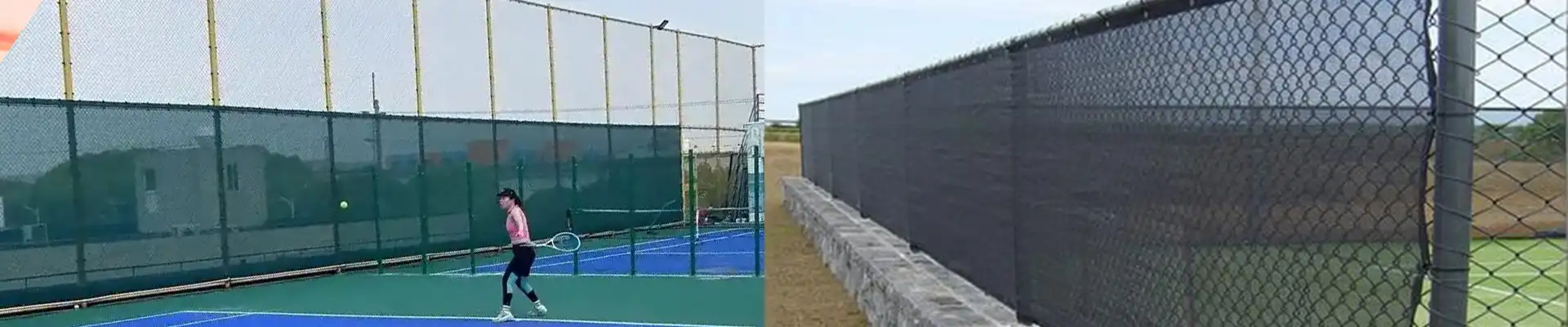
A court's playability isn't just about the surface and the lights—it's about the boundaries. Balls fly out and someone has to chase them. Players cross into adjacent courts. Nearby facilities get hit. These daily inefficiencies add up in operating costs and customer experience. Court barrier netting exists to solve exactly this problem: a wind-permeable, weather-resistant, player-safe net system that keeps balls where they belong, minimizes interference between courts, and imposes minimal burden on installation and maintenance.
The value of court barrier netting breaks down into three layers. The first is ball control. Mesh size determines what passes through and what gets stopped. The 45–50 mm mesh commonly used for pickleball and tennis strikes the right balance between containing the ball and letting wind through. The second is player protection. Balls flying out of the court and hitting pedestrians, vehicles, or players on adjacent courts is one of the most common sources of complaints in court operations. A properly sized barrier net keeps that risk on the other side of the boundary. The third is court manageability. When multiple courts sit side by side, divider netting gives each court its own independent playing space—coaches can run separate lessons, clubs can open different programs simultaneously, and no one interferes with anyone else.
In terms of applications, the scope goes well beyond tennis and pickleball. Tennis court dividers, side-by-side pickleball courts, supplemental boundary protection for basketball courts, hockey arena netting, and baseball spectator protection all follow the same product logic: match the right mesh size and strength to the corresponding ball speed and impact level.
The most common materials for court barrier netting are polyethylene (PE), polypropylene (Pylon/PP), and nylon. Their performance differences directly determine suitable applications and real-world lifespan.
Polyethylene (PE) is the default answer for outdoor barrier netting. PE repels water—it won't gain weight or sag after rain—and with UV stabilizer treatment, it maintains flexibility and color stability under outdoor sun and weather exposure. In the context of court fencing, PE-coated mesh (galvanized steel core with HDPE coating) offers the most balanced overall performance: UV additives keep colors vibrant after 5–8 years of outdoor use, the coating resists cracking, and impact deformation resistance outperforms standard PVC-coated iron mesh. For most community courts, school facilities, and commercial courts, PE delivers the most pragmatic balance of cost, lifespan, and maintenance.
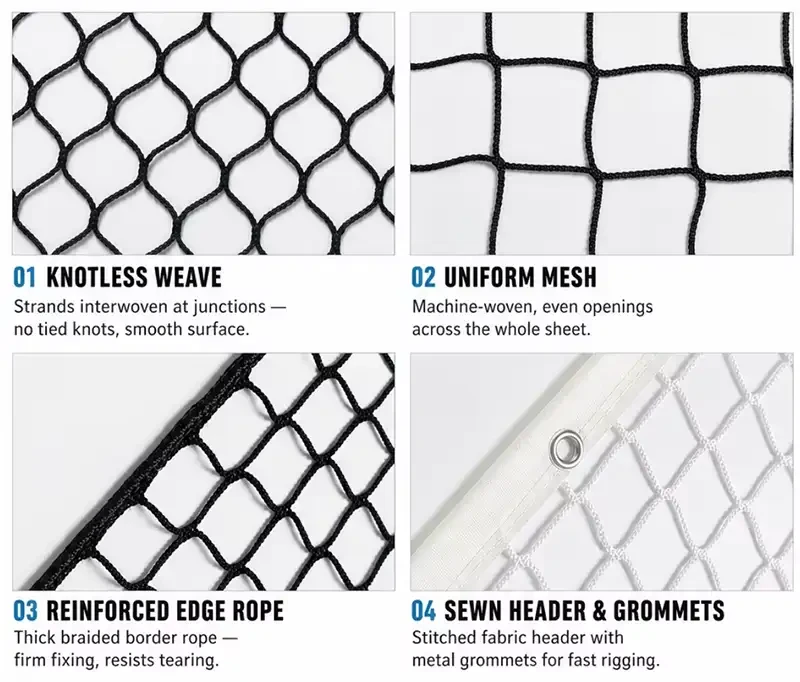
Polypropylene (Pylon) is lighter and more wind-permeable for divider applications. The common#420 knotless polypropylene mesh, with 1-1/2" (approximately 38 mm) square mesh and roughly 125 lb break strength, has become a standard configuration for pickleball and tennis divider systems. The advantage of knotless construction is that the mesh doesn't develop stress concentrations at knots under load—with proper tension installation, it holds its shape better over time. It's also weather-treated for indoor and outdoor use, though in applications requiring higher impact strength, PE or heavier rope diameters are more reliable.
Nylon's advantage is strength; its weakness is outdoor exposure. Nylon has higher break strength per unit weight than PE and better abrasion resistance, but it absorbs water, gains weight, and sags. Repeated wet-dry cycles accelerate aging. It's better suited for indoor facilities or short-term impact scenarios requiring exceptional strength, rather than long-term outdoor barrier exposure.
One often-overlooked detail is color. Dark colors (especially black) offer better UV stability outdoors, fade more slowly, and provide higher contrast as a hitting background, making it easier for players to track the ball.
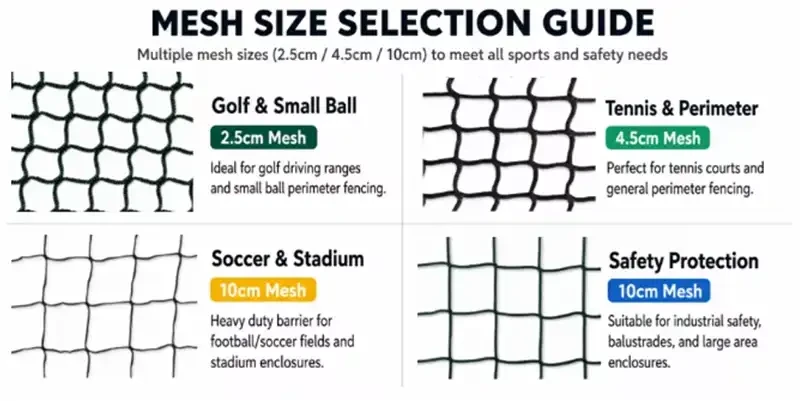
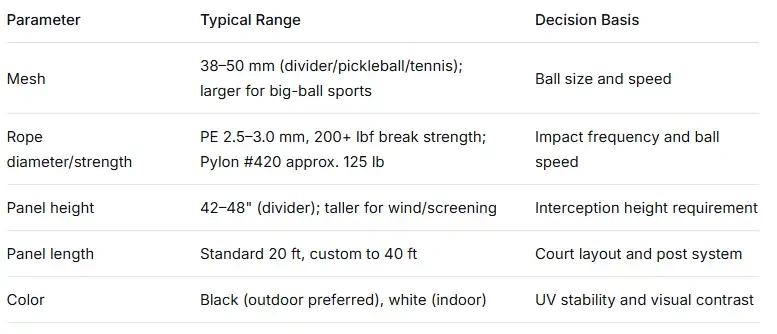
Mesh size is the first decision point. Smaller balls and faster speeds demand tighter mesh. Pickleball recommends approximately 45×45 mm mesh, tennis barrier netting commonly uses 45–50 mm, while soccer, football, and other large-ball applications require larger mesh. The direct consequence of oversized mesh is that balls pass through the holes—rendering the barrier functionally useless.
Rope diameter and break strength determine the net body's ability to withstand repeated impact. For typical PE barrier netting, knotted PE mesh with 2.5–3.0 mm rope diameter at 1-7/8" mesh grade delivers industry-typical break strength of approximately 228 lbf (1.01 kN)—sufficient for daily pickleball and tennis impact. For high-intensity training or faster ball speeds, select heavier rope diameters or higher strength grades accordingly.
For height, divider netting commonly uses 42" (approximately 107 cm) to 4 ft (approximately 122 cm) specifications—enough to intercept low-flying balls. If greater visual screening or wind protection is needed, taller panels or windscreen mesh may be required. Width typically uses 20 ft (approximately 6.1 m) standard panel lengths, with custom widths extending to 40 ft, depending on the support capacity of the post system.
Court barrier netting installation falls into three categories. Which one you choose depends on whether the court is permanent, semi-permanent, or requires frequent setup and takedown.
Surface mount systems suit courts with existing concrete foundations. Posts are bolted directly to the concrete surface via welded base plates—no excavation required—providing semi-permanent stability. Typical surface-mount posts are 3" square steel tube, 11-gauge, with 7×7" base plates and gussets, black powder-coated finish, paired with galvanized steel cable and tension hardware, with maximum recommended panel length of 40 ft.
In-ground sleeve systems are the standard approach for permanent courts. Posts insert into pre-buried sleeves and can be removed when needed to create a "removable permanent court"—stand them up on game day, stow them away when idle. This balances stability and flexibility. For pickleball courts, the standard post spacing is typically 22 ft, and permanently installed posts require a minimum embedment depth of 24" with concrete foundations to resist wind loads.
Portable/frame systems suit temporary partitioning or multi-use courts. Panel ends are made as sleeves that slide directly onto posts, with hook-and-loop straps on Oxford cloth header and footer bands for tensioning, and four-corner anchoring for complete installation. The advantage is that one person can set up and take down quickly—ideal for operations that need to frequently convert court functions.
Regardless of system type, wind load is the most commonly underestimated variable in installation design. Barrier netting itself is wind-permeable, but once windscreen fabric, advertising banners, or dense signage is attached, wind pressure rises significantly. Tennis Australia's technical guidelines explicitly state: if windbreak material or advertising is to be fixed to fencing, post spacing should be reduced to a maximum of 3.33 m, or post diameter and foundation dimensions increased, to compensate for additional wind load. For heightened fencing above 4 m, wind loads increase further—post spacing of 2–2.5 m is recommended to ensure overall frame stability. Tension should be uniform during installation, but avoid "drum-tight" over-tensioning; retaining some elasticity actually helps the net body maintain long-term performance under gusts and impact.
When comparing quotes, the most effective screening method isn't comparing unit prices—it's breaking the problem into four dimensions.
First, indoor or outdoor. Outdoors, prioritize PE or weather-treated polypropylene; reserve nylon for indoor or short-term scenarios requiring extreme strength. In outdoor settings, PE-coated mesh far outperforms standard PVC-coated iron mesh in weather resistance—the latter's plastic layer can become brittle and crack within one to two years of UV exposure, followed by core corrosion and precipitous strength loss.
Second, what ball, what level. Pickleball and tennis barrier netting doesn't require baseball or golf-level strength, but for multi-sport or high-intensity training facilities, rope diameter and break strength should be scaled up accordingly. Mesh must match the ball—this is a non-negotiable baseline.
Third, is the installation condition "with foundation" or "from scratch." Courts with existing concrete should prioritize surface-mount systems, saving excavation and curing time. New construction can use in-ground sleeves for a cleaner permanent result. Temporary or multi-use courts suit portable frame systems.
Fourth, local wind conditions and whether windscreen material will be added. If the court is in a wind corridor, near high-rise buildings, or if advertising and windscreen fabric are planned for the net surface, post spacing, diameter, and foundation dimensions must be designed for enhanced conditions—standard spacing cannot be carried over.
One rule of thumb worth remembering: for most community, school, and club courts, PE-coated mesh with 2.5 mm+ steel core wire and appropriate braiding construction is the most reliable choice across lifespan, performance, and total cost. Aluminum systems have their value in coastal high-humidity or ultra-low-maintenance scenarios, but at 2–3× the cost of PE systems, they represent over-specification for typical projects.
Court barrier netting carries far less maintenance burden than hard fencing—but it's not zero-maintenance. Quarterly checks for loose hardware, mesh damage, or localized deformation, plus soft-brush cleaning and water rinsing to remove attached leaves and debris, will keep the net body in normal condition. Another practical advantage of chain-link braided construction is localized repairability: when a single wire is damaged, only the affected wire needs replacement—no need to swap the entire net—making repairs efficient and cost-effective.
What truly determines long-term maintenance cost is still material and installation quality. Inferior PVC-coated iron mesh can begin corroding within a year in humid environments. Rust doesn't just affect appearance—rusted-through wires create sharp burrs that pose safety hazards. Properly specified PE barrier netting, by contrast, maintains color and flexibility after 5–8 years of outdoor use with virtually no intervention. From this perspective, the extra budget at purchase is essentially buying years of low-maintenance operation.
Court barrier netting isn't the most visible part of court construction, but it takes ball impacts, wind, and sun every single day. Its value isn't in "being there"—it's in using the right material, the right specifications, and the right installation for the right application. When balls stop flying out of the court, when side-by-side courts no longer interfere with each other, when operators no longer spend time chasing balls and patching fencing—that's when the boundary has truly done its job.
If you're planning a new court or adding dividers and protection to an existing facility, start with court dimensions, sport type, and installation conditions to match the right mesh, material, and support system. The right starting point makes the next decade of use simple.
Contact: +8615075482313
WhatsApp: +8615075482313
Email: yingruichina@gmail.com
Add: 100 meters west of Xiliangwa Village, Anping County, Hebei, China
We chat