Quick answer: The performance of Multi-Sport Cage Netting depends on five rope-netting variables: fiber material, knot structure, twine diameter, mesh size, and edge reinforcement. Choose UV-stabilized nylon for high-impact baseball and softball use, polyester for UV stability and large spans, and UV-treated HDPP for cost-sensitive multi-sport training. Use knotted netting where direct high-speed impact durability is the priority, and knotless netting where a smoother surface and clearer visibility matter. Always match mesh size to the smallest ball used—especially golf—and specify a reinforced edge rope for safe load transfer.
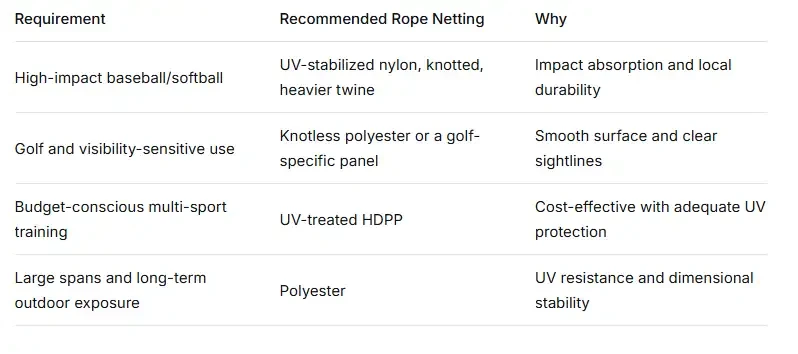
The first performance variable in rope netting is fiber selection. Nylon and polyester are the two most common choices for this product category, and their advantages differ significantly.
The core advantages of nylon rope netting are impact absorption and tensile strength. At the same twine diameter, nylon typically has higher breaking strength than polyester, allowing it to distribute the kinetic energy of a high-speed baseball or softball across a larger net area and reduce localized stress concentration. With UV stabilization, nylon can achieve an outdoor service life of approximately 10–14 years, which is why it is widely used in multi-sport cage netting systems that require higher impact resistance. Carron’s Multi-Sport Cage series uses 100% UV-stabilized nylon as standard, offering #252 knotless nylon for standard loads and #420 knotless nylon for heavy-duty loads.
Polyester rope netting offers advantages in UV resistance and dimensional stability. Polyester is more UV-tolerant than untreated nylon and has low water absorption, so large-span installations are less likely to sag or loosen due to humidity changes. For facilities used mainly for golf practice or exposed to strong sunlight for long periods, polyester rope netting provides practical operational value by helping the net hold its shape.
HDPP (high-density polypropylene) is cost-effective. When UV-treated, it is suitable for low-to-medium impact multi-sport applications. Net World Sports’ Premium-Grade series uses twisted HDPP rope yarn and a glued construction that bonds the strands to prevent abrasion and unraveling. It is positioned for schools, parks, and recreation centers.
Knotted vs. Knotless Rope Netting: Mechanical Trade-Offs
The way rope netting is joined at each mesh intersection directly determines how it “catches” a ball.
Knotted netting is fixed with a knot at every mesh intersection. When a ball hits the net, the impact force is first borne by the knots. Knot deformation and friction absorb part of the energy, buffering the local stress on the fibers themselves. This characteristic gives knotted structures higher overall durability in direct-impact sports, especially against high-speed baseballs and softballs. In addition, local damage in knotted netting is easier to repair—a loose or broken knot section can be re-tied without replacing the entire net panel. Net World Sports’ 48 mm knotted netting also notes that even if a single rope yarn breaks, the knotted structure will not unravel in a chain reaction like knotless netting, so the net face does not become unstable.
Knotless netting forms mesh intersections through braiding or intertwining, with no discrete knot protrusions. Its advantages are a smoother hitting surface and clearer visibility. For close-range golf chips or multi-sport scenarios where players need to see landing points through the net, knotless netting reduces scraping between the ball surface and knot protrusions and reduces visual obstruction for cameras or observers behind the net. Carron uses #252/#420 knotless nylon in its multi-sport cage netting specifically to balance baseball and golf use while taking advantage of the lighter weight and easier overall installation of knotless structures at equivalent strength.
If the main training activity is high-speed baseball/softball impact, knotted netting offers more margin in impact durability.
If the facility is mainly for golf or mixed multi-sport use and is sensitive to visibility and ball-surface scraping, knotless netting provides a better-fit experience.
The load-bearing capacity of rope netting is defined by twine size and mesh size, and both must match the ball characteristics of the target sports.
Carron’s Multi-Sport Cage data provides a useful strength reference:
#252 knotless nylon: approximately 1.5 mm twine diameter, approximately 95 lbs tensile strength.
#420 knotless nylon: approximately 2 mm twine diameter, approximately 135 lbs tensile strength.
Knotted HDPP: 2 mm twine diameter corresponds to approximately 154 lbs breaking strength; 2.5 mm rises to 220 lbs; 3 mm reaches 286 lbs.
These values suggest a practical rule: the boundary between standard-duty and heavy-duty netting is often only about 0.5 mm in twine diameter, but the difference in durability life can be significantly amplified by high-frequency use.
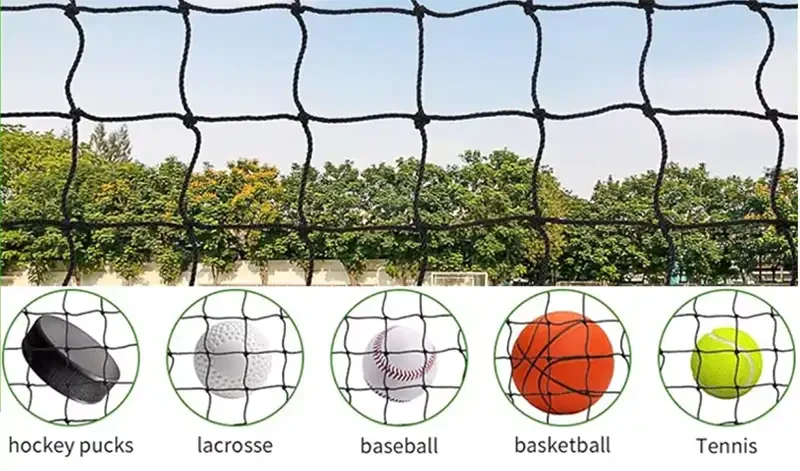
For mesh size, mainstream Multi-Sport Cage Netting options are concentrated in two ranges: 3/4 inch (approximately 19 mm) square mesh and 48 mm (approximately 1 7/8 inch) knotted mesh. A 3/4 inch mesh is the most common choice for baseball/softball cage netting because it effectively contains high-speed balls without adding excessive wind resistance or visual density. When a cage needs to accommodate golf, mesh selection should be based on the golf ball, not the baseball. A golf ball is approximately 42.7 mm in diameter; if the mesh approaches or exceeds this size, containment reliability drops significantly. This is why multi-sport cages that truly accommodate golf often use a dedicated golf-specific net panel on the back wall or golf hitting face rather than expecting one baseball mesh size to do everything.
Edge reinforcement is one of the most underestimated parts of rope netting specification. When a cage net is suspended, edge tension concentrates at the frame and hanging points. If the edge lacks a high-strength rope border, even a strong net body can fail from the outer perimeter first. Mainstream products commonly use 6 mm machine-sewn edge rope or thicker braided rope as perimeter reinforcement to transfer impact loads evenly from the net face to the suspension system. For knotless netting systems, edge sewing quality is especially critical because knotless structures do not have the local self-locking capability of knotted netting; once the edge unravels, damage can spread rapidly across the net.
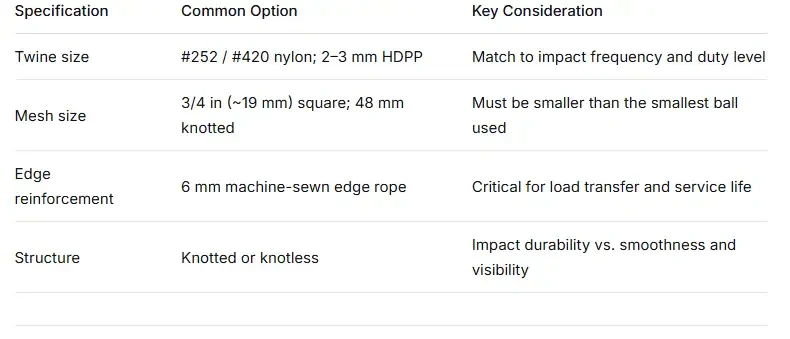
The “multi” in Multi-Sport Cage Netting is essentially a compatibility design of rope netting specifications for different sports balls—not simply a larger version of a single-sport net.
Baseball and softball require rope netting to maintain structural integrity under frequent high-speed impact. #36–#42 gauge nylon or polyester rope netting is the baseline for serious training environments, while #60 and above enters the commercial-grade, high-frequency-use range. Knotted netting has the most obvious local impact-resistance advantage in this scenario.
Golf shifts the focus to penetration containment and ball-surface protection. Golf balls are small, have high initial velocity, and require mesh smaller than the ball diameter. The rope netting surface should also minimize scraping on the ball. Knotless netting is more suitable here, and a golf-specific back-wall panel or independent golf net panel is a more reliable engineering approach.
The rope netting strategy for multi-sport training facilities is zoning by face:
Use knotted heavy-duty nylon on the baseball hitting face to handle primary impact.
Use knotless polyester or a golf-specific net on the back wall or golf face to balance visibility and ball-surface friendliness.
Carron’s multi-sport cage netting supports adding archery netting to the back wall for further strength and functional expansion—an example of this layered design approach.
Multi-Sport Cage Netting rope netting is not a “universal rope.” It is an engineered combination of material selected by impact type, structure selected by primary use, mesh selected by ball diameter, and edge reinforcement selected by suspension method. Choosing the right rope netting specification allows a cage to maintain both containment reliability and operational service life under high-frequency multi-sport use. Choosing the wrong twine diameter or structure cannot be compensated for by a larger cage size—it only adds maintenance cost through localized failure.
Contact: +8615075482313
WhatsApp: +8615075482313
Email: yingruichina@gmail.com
Add: 100 meters west of Xiliangwa Village, Anping County, Hebei, China
We chat