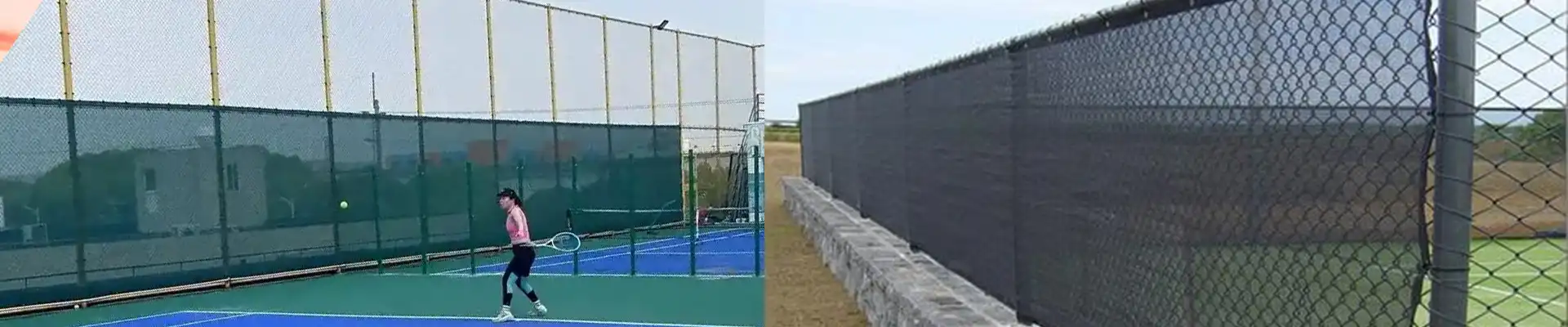
Volleyball Ball-Stop Netting is a protective rope net installed around volleyball courts or training areas to stop stray volleyballs. The standard mesh size is usually 100 mm. Common rope diameters range from 2 mm to 5 mm. The main structures are knotless netting and knotted netting. Common materials include High Tenacity Polypropylene (HT PP), High-Density Polyethylene (HDPE), High-Density Polypropylene (HDPP), nylon, and polyester.
Volleyball Ball-Stop Netting is a protective rope net installed around volleyball courts or training areas. Its primary function is to intercept volleyballs that leave the court, protect spectators and surrounding facilities from high-speed ball impact, and prevent balls from entering unreachable areas and disrupting training continuity. A volleyball can travel at approximately 75 mph (about 120 km/h). In small gyms or training venues, ball-stop netting is an important facility for safety and training efficiency.
The core of Volleyball Ball-Stop Netting is the rope net itself. Different materials, weaving methods, and specifications differ in strength, durability, visibility, and suitable applications. The following sections introduce rope net types systematically.
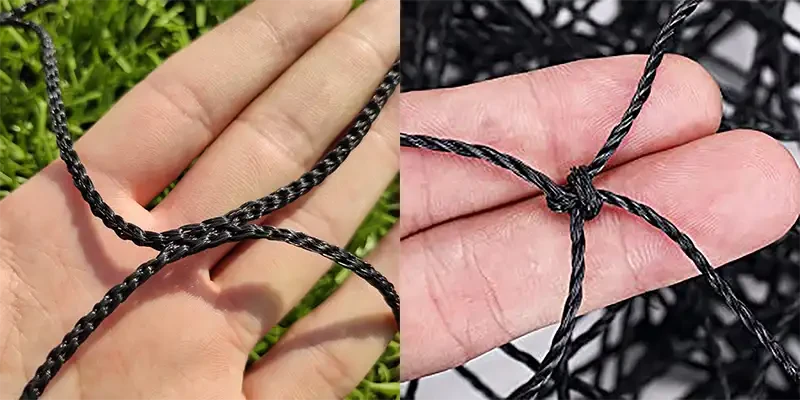
Knotless netting uses a warp-knitted process. The netting yarns are not connected by knots; instead, they are interwoven to form a mesh structure. Its main features are a flat net surface, no raised knots, less friction and wear on the ball, and better visibility.
Typical material: High Tenacity Polypropylene (HT PP) is the most commonly used knotless material for Volleyball Ball-Stop Netting. The Volleyball Ball-Stop Netting offered by Safetynet365 uses HT PP knotless netting, available in rope diameters of 3.0 mm, 4.0 mm, and 5.0 mm, with a standard mesh size of 100 mm.
Performance characteristics: The thicker the rope diameter, the stronger the energy absorption capacity. A 3.0 mm rope diameter is suitable for youth and training scenarios, while 4.0 mm and 5.0 mm are more suitable for adult competition and high-intensity training environments.
Knotted netting forms a mesh structure by tying the netting yarns into knots. It is a more traditional rope net weaving method. Its core advantage is structural stability: even if one netting yarn breaks, because the nodes are independent, the damage does not spread as quickly as in knotless netting, and the net body can still maintain overall protective function.
Typical materials: High-Density Polyethylene (HDPE) and High-Density Polypropylene (HDPP) are mainstream choices. Net World Sports’ Premium-Grade multi-sport barrier netting uses HDPP knotted netting, 48 mm mesh, with twine thickness options of 2 mm, 2.5 mm, and 3 mm, and breaking strengths of 70 kg, 100 kg, and 130 kg respectively.
Typical applications: Duranet’s knotted barrier netting includes polyethylene materials. With a 3 mm rope diameter and 100 mm mesh, the weight is 97 g/m². It is suitable for volleyball, handball, and similar ball sports.
| Material Type | Characteristics | Suitable Applications |
|---|---|---|
| High Tenacity Polypropylene (HT PP) | Lightweight, corrosion-resistant, mature knotless process, good visibility | Indoor and outdoor volleyball ball-stop netting, especially venues needing clear visibility |
| High-Density Polyethylene (HDPE) | Strong weather resistance, UV resistance, low-temperature resistance | Outdoor volleyball courts, windy and rainy areas |
| High-Density Polypropylene (HDPP) | High strength, creep resistance, knotted process | High-intensity training venues, multi-sport shared barrier netting |
| Nylon | Good elasticity, wear-resistant, lightweight | Portable training barrier netting, temporary protection |
| Polyester | High tensile strength, dimensional stability | Long-term fixed installation court enclosures |
Nylon barrier netting usually uses 3 mm knotless rope with a 6 mm thick border rope, and a mesh size of 4 in × 4 in (about 100 mm). It can effectively intercept balls larger than 4 in in diameter and is suitable for shared use in volleyball, basketball, and other sports. Its UV and weather-resistant treatment ensures durability for long-term outdoor use.
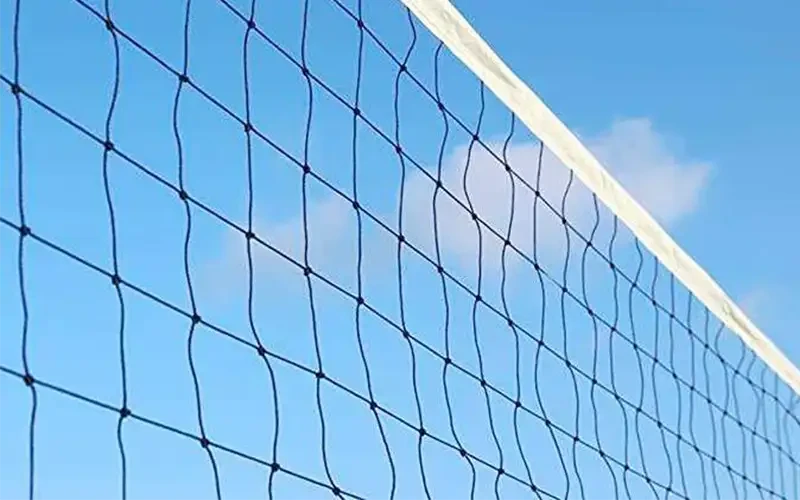
When selecting Volleyball Ball-Stop Netting, the following parameters directly affect protection performance and user experience:
Mesh Size: The standard mesh size for volleyball is 100 mm. Multiple professional sources confirm this specification: Safetynet365 volleyball ball-stop netting has a standard mesh of 100 mm; Duranet’s recommended volleyball barrier netting also uses 100 mm mesh; Nets4You’s barrier netting selection guide also classifies volleyball under the 100 mm mesh category. Because a volleyball is approximately 210 mm in diameter, a 100 mm mesh is sufficient to prevent the ball from passing through.
Rope Diameter / Twine Thickness: Common ranges are 2 mm to 5 mm. The thicker the rope diameter, the stronger the impact resistance. For high-intensity adult training, 4 mm and above is recommended.
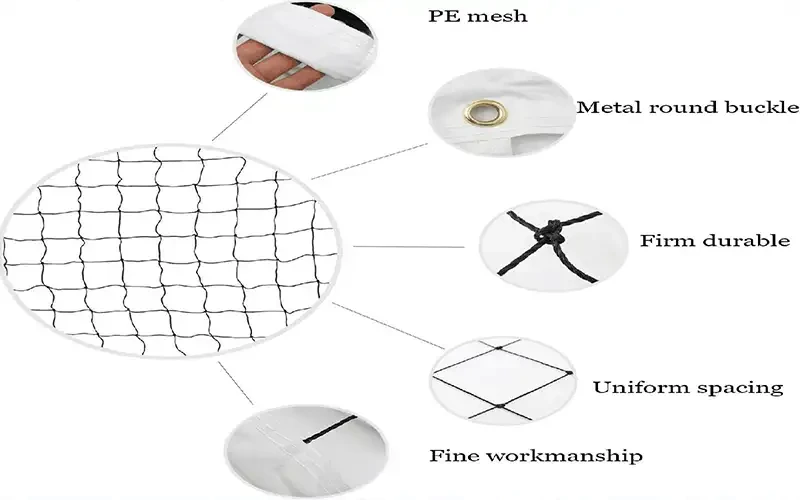
Border Reinforcement: Almost all professional volleyball ball-stop nettings are equipped with a 6 mm or thicker border rope, fixed around the net body by sewing or threading to enhance edge strength and provide hanging/fixing points.
Size Specifications: Volleyball ball-stop netting is usually graded by height. Common heights are 3 m, 4 m, and 6 m, and length can be customized according to the venue. Net World Sports’ barrier netting system offers three height options: 12 ft (3.7 m), 20 ft (6 m), and 26 ft (8 m).
Training Venues: 3.0 mm HT PP knotless netting, 100 mm mesh, is recommended. It is lightweight, has good visibility, and is easy to install and take down quickly.
Competition Venues: 4.0–5.0 mm HT PP knotless netting, 100 mm mesh, with B1 flame-retardant treatment, is recommended. Stronger energy absorption handles high-speed spikes.
Outdoor Venues: HDPE or HDPP knotted netting, 100–120 mm mesh, 2.5–3 mm rope diameter, is recommended. It is UV-resistant and weather-resistant, and damage does not spread easily.
Multi-Sport Shared Use: HDPP knotted netting, 48 mm mesh, 2–3 mm rope diameter, is recommended. It can intercept volleyballs, basketballs, soccer balls, and other balls at the same time.
There are three main installation methods for Volleyball Ball-Stop Netting:
In-ground installation — aluminum or steel posts fixed with pre-cast concrete sockets, suitable for permanent installation.
Ground sleeve installation — posts inserted into ground sleeves and can be removed manually.
Freestanding frame installation — with H-style base or ground stakes, no civil construction required.
Professional barrier netting systems usually equip each post with pulleys, rope cleats, and pull ropes, allowing the net body to be raised and lowered easily and reducing damage risk by lowering the net in strong winds. The 6 mm border rope on the edge of the net body is fixed to the posts with zip ties or rope lock clips, and installation and removal can be completed in a short time.
What is Volleyball Ball-Stop Netting?
Volleyball Ball-Stop Netting is a protective rope net installed around volleyball courts or training areas to stop stray volleyballs, protect people and property, and keep training continuous.
What mesh size is standard for Volleyball Ball-Stop Netting?
The standard mesh size is 100 mm. Since a volleyball is about 210 mm in diameter, 100 mm mesh prevents the ball from passing through.
Should I choose knotless or knotted netting?
Choose knotless netting for better visibility, less ball wear, and easier handling. Choose knotted netting for greater structural stability, especially outdoors or in multi-sport use.
What is the best material for outdoor Volleyball Ball-Stop Netting?
HDPE or HDPP knotted netting is generally best for outdoor use because of UV resistance, weather resistance, and stable structure.
What rope diameter should I use?
Use 3.0 mm for youth and training. Use 4.0–5.0 mm for adult competition and high-intensity training.
Can Volleyball Ball-Stop Netting be used for other sports?
Yes. HDPP knotted netting with 48 mm mesh and 2–3 mm rope diameter can also be used for basketball, soccer, and other sports.
Contact: +8615075482313
WhatsApp: +8615075482313
Email: yingruichina@gmail.com
Add: 100 meters west of Xiliangwa Village, Anping County, Hebei, China
We chat