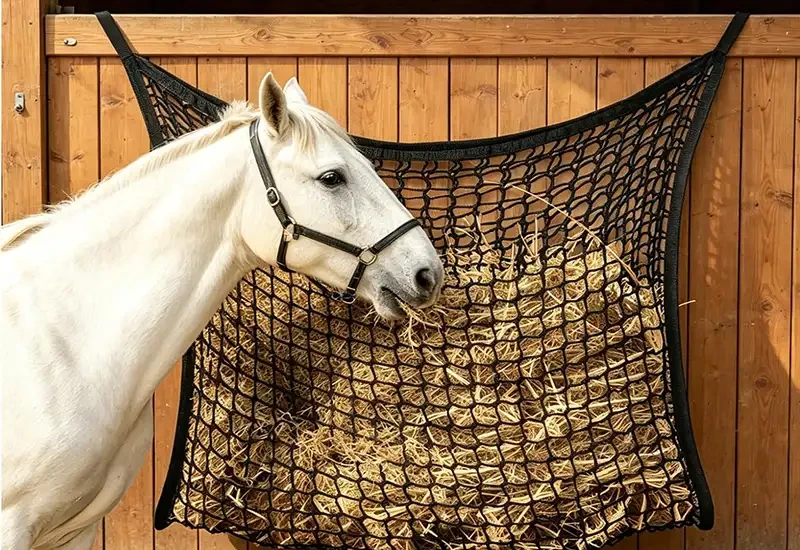
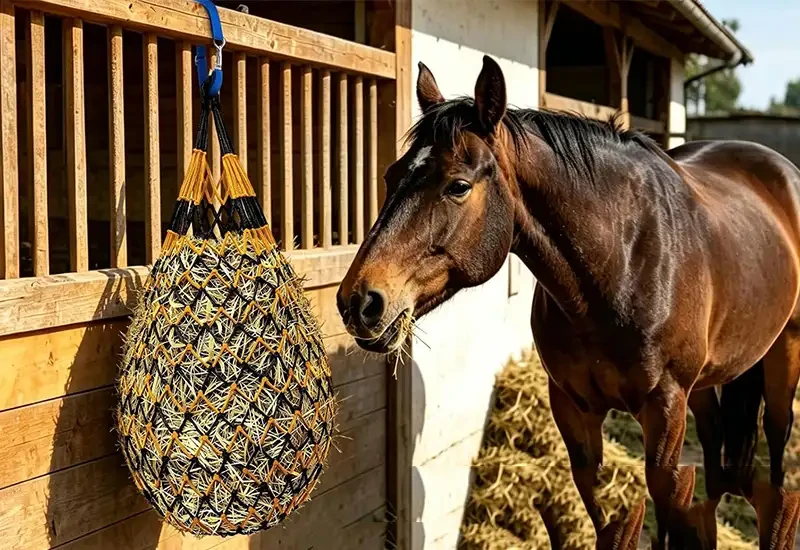
A Slow-Feed Hay Net is a feeding tool designed for horses and other herbivores. It works by placing hay inside a net bag or net cover with small mesh holes, forcing the horse to take smaller bites and eat more slowly. Its core design concept is to simulate the continuous grazing behavior of horses on natural pasture, extending hay that might otherwise be consumed in only a few hours into a feeding rhythm that is closer to all-day foraging.
Horses are, by evolutionary design, continuous feeders. Their digestive systems and psychological behavior are adapted to eating small amounts almost continuously throughout the day. However, modern barn management often uses scheduled, measured meals, which can cause horses to consume large amounts of hay in a short period and then experience long fasting intervals. This not only increases the risk of gastric ulcers, colic, and other digestive diseases, but also predisposes horses to stereotypies such as wood chewing, pacing, and windsucking. The slow-feed hay net was designed to address this conflict in feeding management.
The most direct benefit of a slow-feed hay net is extending the horse’s feeding time. A systematic review covering 26 studies showed that using hay nets can extend feeding time by approximately 40%. The exact increase depends on hole size, number of net layers, and hay type. Another study further found that after using a hay net, daily feeding time increased from 257 minutes to 659 minutes, while intake rate dropped from 1,592 g/hour to 610 g/hour.
Longer feeding time means hay enters the stomach continuously and slowly, providing ongoing buffering against gastric acid and effectively reducing the risk of gastric ulcers and colic. Experts at Kentucky Equine Research note that slow eating and feed intake, including hay, help achieve more efficient and complete digestion while reducing sharp fluctuations in metabolites such as glucose and insulin.
Hay waste is an often underestimated cost in barn management. With traditional floor feeding or open hay racks, horses scatter large amounts of hay onto the ground, where it mixes with bedding, dirt, and manure and can no longer be eaten. Data from systematic reviews show that slow-feed hay nets can reduce hay waste from 57% to as low as 6%, while slow feeders can reduce it to 13%. Economic analysis shows that the savings from reduced waste alone can recover the purchase cost of slow-feeding equipment within one year.
By simulating natural feeding rhythms, slow-feed hay nets have multiple positive effects on equine digestive health. Studies show that longer feeding time helps stabilize blood glucose and insulin levels, which is especially important for horses with laminitis, insulin resistance, or Cushing’s syndrome/PPID. Some studies also report that horses fed using hay nets lost 20–23 kg, while floor-fed control horses gained weight. For easy keepers and horses with metabolic syndrome that need weight control, the slow-feed hay net is an effective non-drug management tool.
Stereotypic behaviors in horses, such as cribbing, windsucking, weaving, and wall-kicking, often stem from boredom and stress caused by insufficient feeding time. The chewing and foraging process of a hay net itself acts as environmental enrichment, providing the horse with a continuous behavioral outlet. The systematic review noted that hay nets and slow feeders can reduce stereotypies such as cribbing and weaving. Chewy’s veterinarian-reviewed guide also lists hay nets as an effective tool for reducing boredom and stereotypies in horses, recommending them as part of stall and pasture enrichment.
Mesh hole size is the most critical factor when choosing a slow-feed hay net. It directly affects feeding speed, horse acceptance, and net durability.
| Mesh Hole Size | Best Use | Effect Characteristics |
|---|---|---|
| 1 inch (approx. 2.5 cm) | Horses with laminitis, severely obese horses, horses requiring strict intake control | Slowest feeding speed, but some horses may become frustrated |
| 1.5 inches (approx. 3.8 cm) | General choice for most horses; ideal size for simulating natural feeding | Balances extended feeding time with avoidance of excessive frustration |
| 1.75–2 inches (approx. 4.4–5 cm) | Large horses such as Warmbloods and draft horses, senior horses, aggressive eaters | First choice for transition; high acceptance and less frustration |
| 2.5 inches or larger | Mainly used to reduce waste rather than significantly slow feeding speed | Limited effect on extending feeding time |
It is recommended that horses new to slow-feed hay nets start with larger holes (1.75–2 inches) and gradually transition to smaller hole sizes after the horse adapts. For horses with laminitis or insulin resistance, studies recommend using hay nets with holes no larger than 2 inches to give the liver enough time to process excess sugar.
It is important to note that hole size should never exceed the width through which a horse’s hoof can pass, in order to prevent hooves from becoming trapped in the net and causing injury.
Slow-feed hay nets on the market are mainly made from three industrial materials: PP (polypropylene), polyester, and PE (polyethylene). The three differ in fiber density, flexibility, abrasion resistance, and UV aging resistance. The choice should be based on the horse’s eating temperament and the management setting.
In terms of weave construction, knotless design is the current mainstream trend. Knotless weaving reduces wear on the horse’s teeth, lowers the risk of rope entanglement, and provides a softer, more comfortable feeding experience while maintaining strength. Heavy-use round bale hay nets are usually made from high-strength polypropylene or nylon, and some products use 240-strand construction to enhance durability.
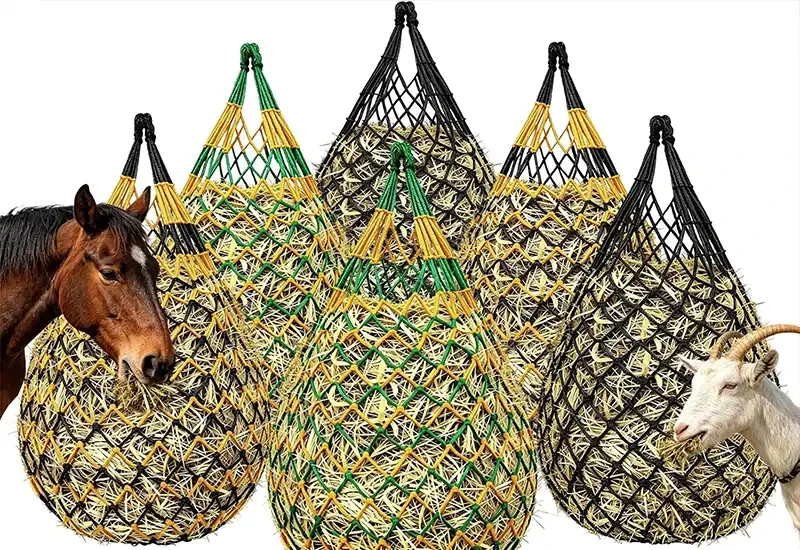
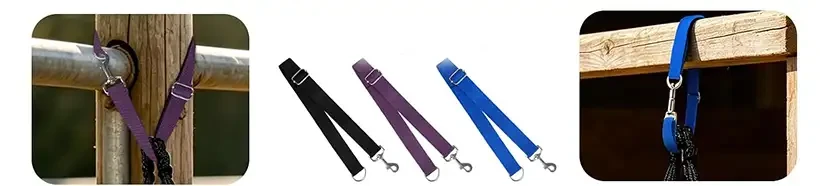
Slow-feed hay nets can be divided into the following categories by capacity:
Single-flake or multi-flake hanging small nets: Suitable for single feeding in stalls. They usually hold 2–5 flakes of hay, are affordable, and are suitable for first-time users.
Square bale hay nets: Cover an entire square bale. Medium capacity, suitable for medium-sized barns.
Round bale hay nets: Cover an entire round bale. Capacity can reach 1,000–2,200 lb (approximately 450–1,000 kg), suitable for pasture grazing and large barns.
Round bale hay nets usually come with self-locking ties, needles, and repair rope. During installation, unroll the net over the bale and tighten the ties to secure it.
Hanging Height: The general recommended hanging height for a hay net is 4.5–5 ft (approximately 1.4–1.5 m) above the ground. If it is too low, a horse’s hoof may step into the net. If it is too high, it forces the horse to eat with an unnatural head-up posture, increasing neck muscle tension and musculoskeletal strain. If conditions allow, ground-based slow feeders, where the hay net is placed at or near ground level, can better simulate the horse’s natural head-down feeding posture.
Filling: After loading hay into the net, close the top with the drawstring or tie. Some products are equipped with patented closure systems that make filling easier. A practical tip is to choose a net one size larger than the bale, which makes it easier to fit over the bale and allows the closure to be tightened more securely.
Adjustment Period: Horses may need a short adjustment period when first introduced to a slow-feed hay net. It is recommended to start with larger holes and observe whether the horse shows obvious frustration behaviors, such as frequently tossing the net, pawing, or chewing the net ropes. If frustration behaviors persist, try adjusting the hanging height or switching to a larger hole size. The systematic review specifically notes that overly restrictive hole designs can sometimes trigger frustration, pawing, and net tossing. Therefore, design choices must balance feeding efficiency with horse welfare.
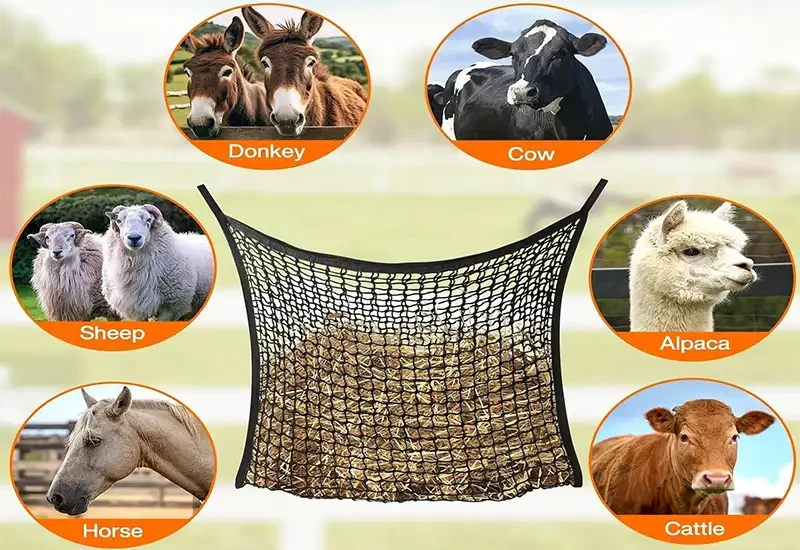
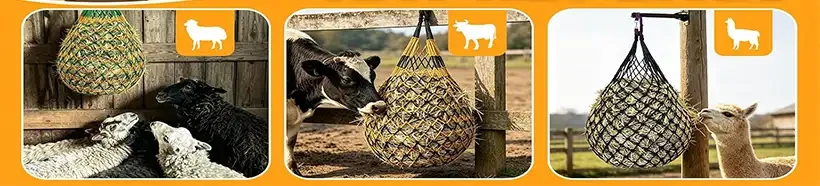
Slow-feed hay nets are suitable for all herbivores that rely on hay as their main source of forage, including horses, ponies, donkeys, mules, and goats. They can be used in barns, paddocks, during trailer transport, and in pasture grazing areas.
The following types of horses are especially suitable for slow-feed hay nets:
Easy Keepers: Horses that need limited intake but should not have total feeding time reduced.
Horses with laminitis or insulin resistance: Horses that need stable glucose metabolism.
Horses prone to stereotypic behaviors: Horses that need more feeding-related behavioral output.
Senior horses or horses with poor dentition: Knotless nets can reduce tooth wear.
Horses left alone for long periods: Hay nets provide longer-lasting feeding activity and help relieve separation anxiety.
Q: Do slow-feed hay nets wear down horses’ teeth?A: Current research shows that hay nets have a relatively small direct effect on teeth, but long-term effects require further study. Choosing knotless woven nets can minimize potential tooth wear.
Q: Can horses get enough hay from a slow-feed hay net?A: Yes. Slow-feed hay nets limit feeding speed, not total intake. Horses can still consume enough hay over an extended period, and continuous small meals are closer to their physiological needs.
Q: Will using a slow-feed hay net increase frustration in horses?A: This depends on the hole size selected and individual differences. A moderate feeding challenge usually does not cause persistent frustration, but holes that are too small or improper hanging methods can increase frustration behaviors. It is recommended to start with larger holes and adjust gradually.
Q: How should I choose between a round bale hay net and a square bale hay net?A: It depends on your feeding scale and bale type. Round bale nets are suitable for pasture grazing and large barns. They have large capacity but are relatively more complex to install. Square bale nets are suitable for daily stall feeding and are easier to handle.
Q: How long do slow-feed hay nets last?A: High-quality knotless nylon or polypropylene nets typically last 1–3 years under normal use, depending on the horse’s eating habits, frequency of use, and UV exposure. Choosing UV-stabilized products can extend outdoor service life.
The Slow-Feed Hay Net is not just a feeding tool; it is an indispensable part of an equine health management system. By simulating natural feeding behavior, it supports horse welfare across multiple dimensions: extending feeding time, improving digestive health, reducing feed waste, and reducing stereotypic behaviors. With the right mesh hole size and material, combined with correct installation and usage, a slow-feed hay net can become a long-term investment with both economic and welfare value in daily barn management.
Contact: +8615075482313
WhatsApp: +8615075482313
Email: yingruichina@gmail.com
Add: 100 meters west of Xiliangwa Village, Anping County, Hebei, China
We chat